

20 Years of Counting on Grace
/by Isabella Posel
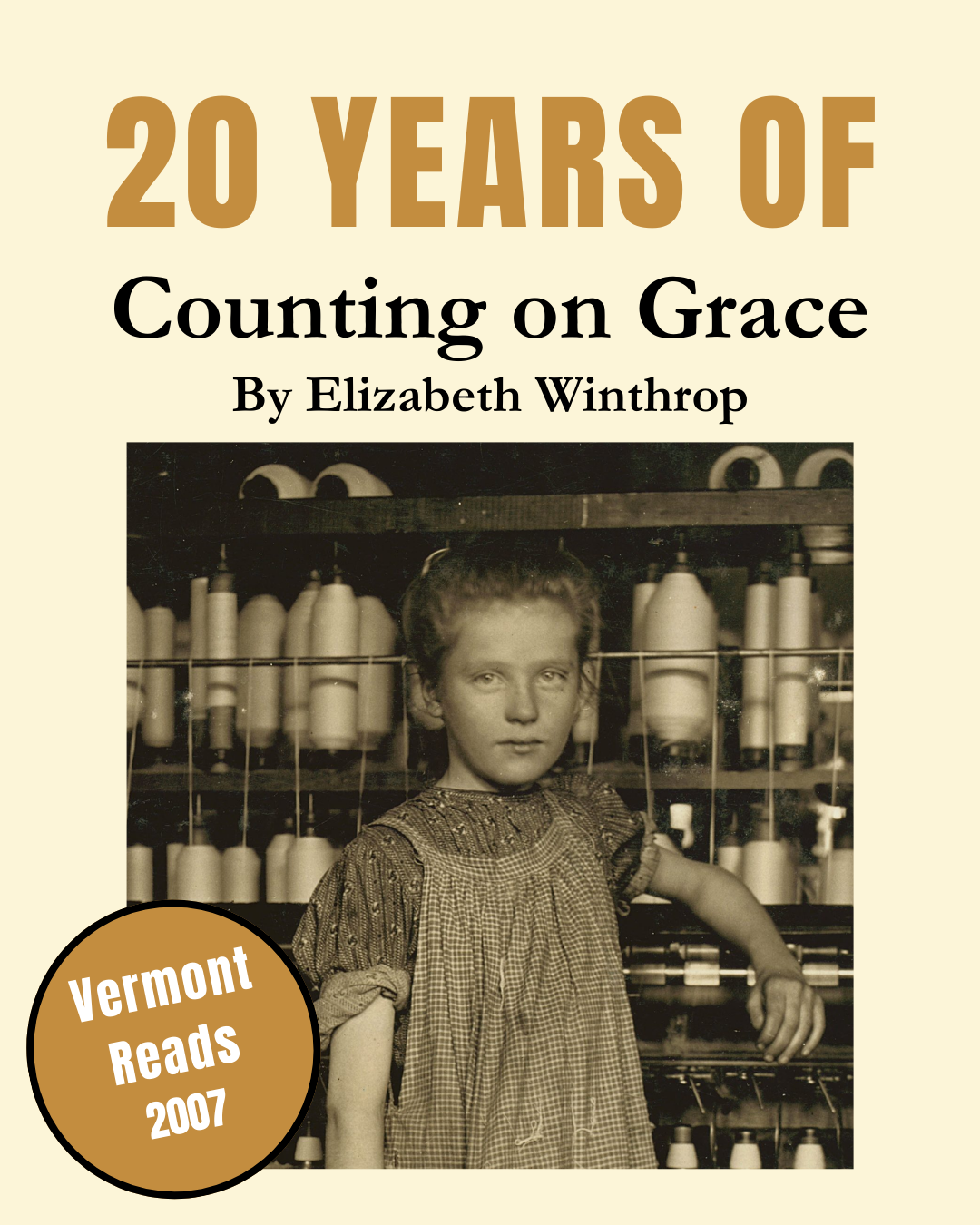
20 years ago, on March 14, 2006, Elizabeth Winthrop’s celebrated historical fiction novel Counting on Grace was released. This young adult novel was soon met with critical acclaim and even made the 2007 Vermont Reads pick. Counting on Grace follows a young French-Canadian immigrant, Grace, who is employed in a textile mill as a doffer for her mother at the age of 12. In honor of this anniversary, I had the opportunity to speak with Elizabeth Winthrop.
“I believe very strongly that readers, particularly kids, can take in a lot of history through fiction and they can imagine themselves as Grace. So, when I talk in a school I say to kids, ‘what if you had to work 6 days a week, 12 hours a day for $2.50 a week and you had no education. You weren’t going to go to school, you were never going to get beyond that’ and that really hits home,” says Winthrop, discussing how historical fiction like Counting on Grace can further learning and understanding.
Winthrop wrote Counting on Grace after seeing a photograph taken by Lewis Hine for the National Child Labor Committee captioned “anemic little spinner,” showing Addie Card at work in a textile mill in Pownal, Vermont. At the time, Winthrop knew nothing about Addie — even the name given was incorrect. After writing the novel, however, Winthrop set about finding the real Grace.
She describes researching the photograph, saying, “I almost felt like I'd robbed her. I'd taken her image and used it. I thought I at least have to dig her out of the dustbin of history.”
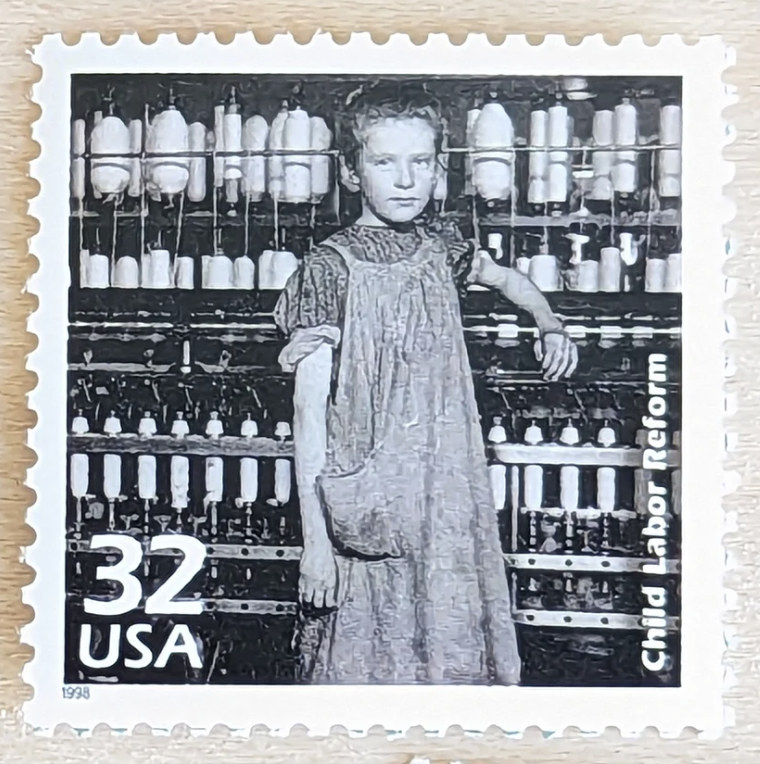
1998 US Postage Stamp
Working with historian Joe Manning (who since located many more Hine children), Winthrop looked through census records, marriage licenses, birth certificates, and more until she discovered Addie’s true identity. She traveled to Hoosick, New York to share the photograph and its legacy with Addie’s descendants, who knew her as Gramma Pat and never knew about her time working in a textile mill (or the subsequent fame of the photograph which was used in a Reebok ad and as a postage stamp, as well as to spread awareness regarding child labor). Manning and Winthrop were able to correct Addie’s name on signs outside the Pownal mill as well as in the Library of Congress.
20 years later, Counting on Grace feels just as relevant as it did when it was released, or even when it took place, over a hundred years ago. We can still learn from its themes of immigration, child labor and exploitation, and the importance of education.
“History doesn’t feel like ‘oh that happened 100 years ago, what do I care?’ It makes it more relevant for today. Grace probably would have been thrown out, taken away, even though she was born here; her parents were Canadian — they slipped across the border,” Winthrop explains, "It's all about transactions around people; that’s the most important thing to think about when you consider the kinds of issues being brought up right now by this administration.” As we consider current news and reform regarding these topics, such as the “worldwide epidemic” of child labor and laws lowering the working age across the nation, it is more important than ever to learn from history and stories like Grace’s.
Our upcoming exhibit, Investigating Child Labor, allows visitors to learn more about the photography of Lewis Hine and how it connects to both the history of child labor at mills like the one in which Grace and Addie Card worked, as well as child labor issues today. Investigating Child Labor opens at the Heritage Winooski Mill Museum on April 2 and is open to the public 12-4 on Thursdays and Fridays.

Isabella Posel is interning at the Mill Museum this spring during her freshman year at UVM. She studies English and Public Communications, and has a keen interest in museum studies, archival work, and library science. She is also a writer and artist, and hopes to work in the cultural heritage sector.